

Your rankings are solid. Your traffic looks fine on paper. But the intake line is quieter than it should be — and you're not imagining it. In 2026, zero-click AI results answer client questions before they ever reach your website. When they do visit, small trust gaps stop them from calling. And without a strong entity-based digital presence, AI systems recommend your competitors instead of you. This article diagnoses why rankings and revenue have stopped being the same thing — and what to fix first.
If you feel like your SEO report is "all green," but your intake line is quiet, you're not imagining things. In February 2026, search works less like a directory and more like a cautious assistant. It answers the easy questions itself, then "refers" only a few firms when someone looks ready to hire.
That shift creates a painful new truth: you can hold a #1 ranking and still lose calls.
What's happening is simple, even if it's frustrating. Visibility isn't the same as demand, clicks, or trust. AI answers and zero-click results reduce website visits, even when rankings stay strong. Then, when people do reach your site, small trust gaps can stop them cold. Finally, even qualified leads can slip away if your intake response is slow.
This article helps you diagnose what changed, and what you can control next: your entity-based digital presence, your on-page conversion proof, and your intake speed.
Perfect rankings can still mean fewer clicks in a zero-click, AI-first world
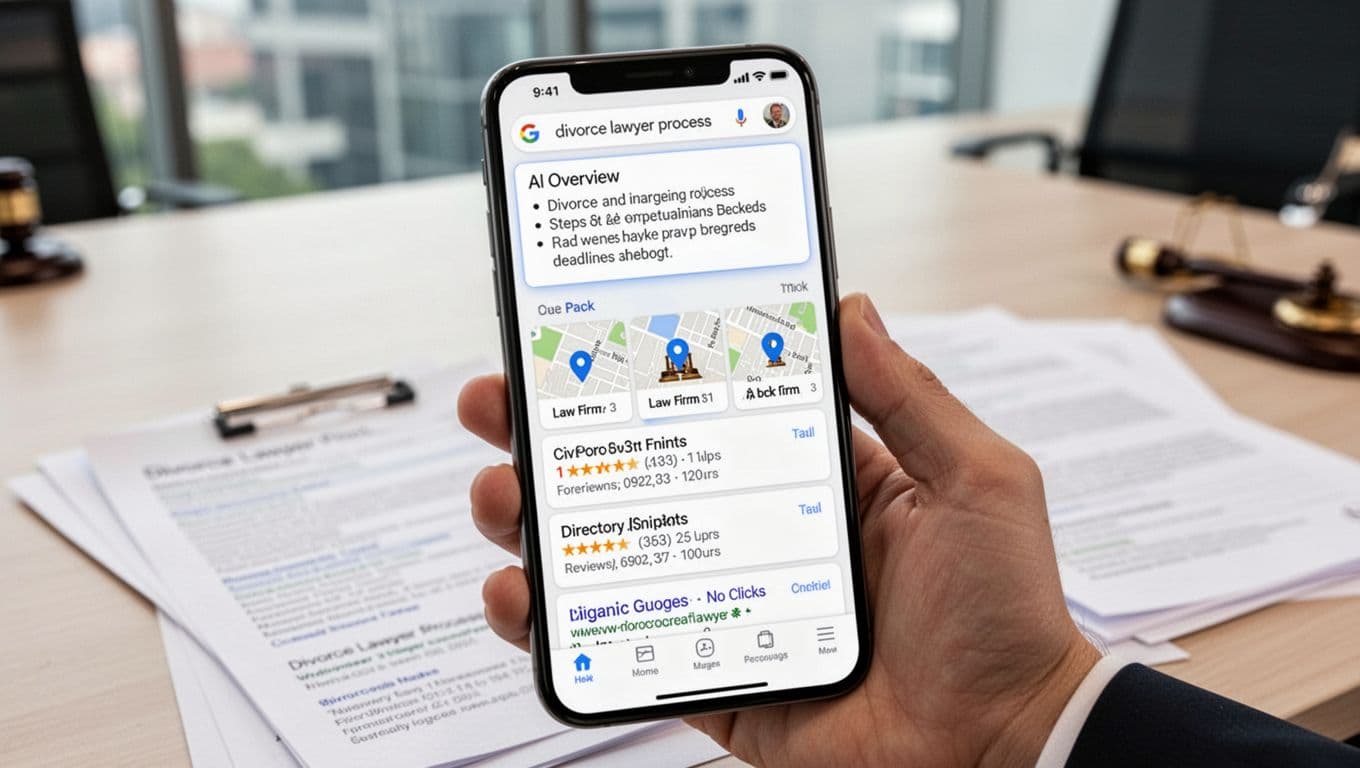
Search results now answer many legal questions before a client ever visits your website, created with AI.
For years, the pattern was steady. A person searched, clicked a few sites, then called the firm that felt right. Rankings mattered because clicks followed.
Now, the search page often finishes the job before a click happens. Google shows AI Overviews, map packs, "people also ask," review summaries, and directory blocks. Many users stop there.
Recent industry reporting through 2025 shows about 58 to 68 percent of Google searches end with no click. For informational searches, the zero-click rate is even higher. Even for local and commercial intent queries, a large share ends without a site visit.
Here's the shift in one quick comparison:
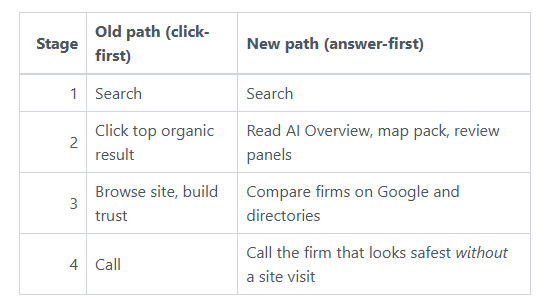
Your rankings still help, but they no longer guarantee traffic. You can "win SEO" and still lose the moment where your website used to persuade.
If the search page answers the question and resolves anxiety, the click becomes optional.
When Google answers for you, your website never gets the chance to convert
This hits law firms hardest on topics that used to build early-stage trust. Think of queries like:
- What's the deadline to file after a car accident?
- How does probate work?
- What happens at an arraignment?
- Can I expunge a conviction?
These are research questions, not "hire now" questions. AI Overviews summarize the process, list typical steps, and sometimes mention timelines. As a result, your blog post can stay ranked, but your sessions drop. Your content still influences the decision, yet it doesn't always earn the visit.
That's why the phone can stop ringing while your position stays "perfect." Your SEO report measures where you appear. It doesn't measure how often Google lets you meet the client on your own site.
Your real competitors are not just law firms anymore, they are AI answers, maps, and directories
It's also not just Google. Clients ask AI chat tools the same questions they used to type into search. Then they move straight to "best firm near me," "reviews," and "who answers fast."
Meanwhile, the decision happens on third-party surfaces:
- Google Business Profile (hours, photos, services, Q&A)
- Map pack listings and "near me" results
- Legal directories (practice areas, badges, peer ratings)
- Review platforms that show up above organic links
In other words, you're competing with the format of the results page. If a client can choose a firm based on reviews, proximity, and a confident profile, your website may never enter the picture.
That's the new battleground: where choices get made before a click.
If people do click, a trust gap on the page can quietly kill the call
Let's assume you still get visitors. These are often high-intent, stressed people. They don't read like a marketer. They scan like a person in a waiting room, checking for danger.
So, even small issues can cut calls fast:
- The phone number is hard to find on mobile.
- The site loads slowly on a weak connection.
- The messaging feels broad, like it fits any firm.
- The page asks for too much before giving reassurance.
- The first step is unclear, or sounds expensive.
In legal, "almost trusted" often equals "not called."
A common pattern shows up in analytics: you rank well, you get fewer clicks because of zero-click features, and the clicks you do get bounce because the page doesn't close the trust gap quickly.
Your homepage might be talking about you, not the client's urgent problem
A homepage can quietly push clients away when it reads like a résumé.
"Full-service." "Aggressive representation." "Decades of combined experience." None of that tells a scared person, "You're in the right place."
Instead, focus your above-the-fold area on four plain points:
- Who you help (the situation, not the practice area label)
- What you do (one clear outcome, no legal poetry)
- What happens next (what the first call is like)
- How to start (one primary call-to-action)
A simple "What happens in the first 15 minutes" section often outperforms a long list of practice areas. It lowers fear and sets expectations.
If you need a model for conversion-focused structure, a dedicated landing page often beats a catch-all homepage. This is where a focused page strategy can help, especially when you pair it with high-converting landing page design for each practice area and city.
Your proof is not strong enough for a high-stakes decision
Legal clients need proof because the risk feels personal. They want to know you're real, competent, and responsive. They also want signals that other people trusted you and didn't regret it.
Strong proof usually includes:
- Recent, authentic reviews (and replies that sound human)
- Case results where allowed (with clear disclaimers)
- Verdicts and settlements (again, where allowed)
- Bar admissions, court admissions, and associations
- Speaking, publications, and meaningful community roles
- Attorney bios that show the person behind the license
- Clear FAQs about fees, timelines, and communication
- A short intake expectations section (what you need, when you respond)
Compliance matters here. Avoid promises. Avoid guarantees. Follow your state bar rules, and add the right disclaimers. Done right, this doesn't weaken your message. It strengthens trust because it feels careful and professional.
If you're rebuilding your review strategy, start with a clear system for requesting and showcasing them. The practical guidance in online reviews for attorneys pairs well with conversion updates because it supports both map visibility and on-page confidence.
Entity-based digital presence is what turns visibility into recommendations
Rankings show where you appear. Recommendations happen when platforms believe you're a safe choice.
In 2026, Google and AI tools act less like keyword matchers and more like identity checkers. They try to understand your firm as an entity, meaning a real organization with consistent details, proven activity, and stable authority.
That's why entity-based presence matters. When your entity-based digital presence is strong, you show up more consistently across maps, directories, and AI-driven summaries. When it's weak, you look "uncertain," even if your website ranks.
This also explains a common surprise. You may have a great site, but a competitor with cleaner listings and better review volume gets the calls because they look easier to verify.
Your firm needs one identity everywhere, or AI and clients hesitate
Think of your firm's online identity like a file that multiple assistants share. If one assistant has an old phone number and another has a different address format, they stop trusting the file.
Start with the basics (because basics still break firms):
- Name, address, and phone consistency (NAP)
- Office hours that match across platforms
- Primary and secondary practice areas that don't conflict
- Attorney names that match bios, directory profiles, and bar listings
Then check for common culprits:
- Duplicate Google Business Profiles
- Old suite numbers, old tracking numbers, old "temporary" phones
- Directory listings that still show a former partner or retired attorney
- Multiple sites or microsites competing with each other
None of this feels exciting, but it directly affects whether your entity looks stable. When your entity-based presence weakens, your visibility becomes less useful, and your phone rings less.
Trust signals that AI can find, understand, and trust (and clients can feel)
You need trust signals that both humans and machines can recognize quickly. Some are public, like reviews. Others are structural, like how clearly your site labels people, services, and locations.
This is where structured information helps. When your site clearly marks up attorneys, practice areas, locations, and reviews, you reduce ambiguity. That supports entity recognition and strengthens your entity-based digital presence across platforms that summarize and recommend.
If you want the clearest explanation of what to implement, use this guide on structured data for law firm SEO. It connects the technical pieces to real outcomes, like richer search results and clearer local signals.
A quick real-world example: when your Google profile shows one phone number, your directory listings show another, and your site header shows a third, you're forcing doubt into the process. Unifying those details won't feel like "marketing," but you often see fewer missed opportunities because people stop hitting dead ends.
A fast, friction-free intake system is the new ranking factor you control
Even if you fix clicks and trust, intake can still kill the lead.
In 2026, the firm that responds first often wins. That's not because clients are impatient. It's because legal problems create stress, and stress creates urgency. If a person reaches out and hears nothing, they keep calling down the list.
You can have perfect rankings and still lose the case because:
- Calls route to voicemail during business hours.
- After-hours calls get a generic greeting and no reassurance.
- Forms go to an inbox no one monitors.
- Chat tools collect info but don't schedule anything.
- The follow-up is slow, or feels cold.
The fix is operational, not theoretical. You're building a system that makes it easy to reach a human and easy to take the next step.
Run a missed-call audit before you spend another dollar on marketing
Before you add budget, test what a real prospect experiences. Do it like a secret shopper, and do it on a normal workday.
Here's a short audit you can run in one hour:
- Call your main line during business hours from a mobile phone.
- Call after hours, and listen to the full voicemail greeting.
- Use your website contact form, then time how long it takes to get a reply.
- Try chat, if you have it, and see if it reaches a real person.
- Test your "tap to call" button on iPhone and Android.
As you test, listen for friction:
- Too many menu options before you reach intake
- A long greeting that delays reassurance
- No mention of what happens next
- No "If this is urgent, do this now" guidance
Small changes here can recover leads you already earned.
Build a follow-up loop that fits how legal clients actually decide
Most prospects don't choose a firm in one moment. They narrow options, talk to one firm, then compare. Your job is to stay present without sounding pushy.
A simple follow-up loop works because it matches real behavior:
- Respond fast with a call (minutes to hours, not days).
- Send a short text if you miss them (confirm you tried, ask for a good time).
- Email a brief summary (what you need from them, what happens next).
- If you don't connect, try again the next business day.
Keep the tone calm and direct. Use plain language. State what you can do, what you need, and when they'll hear from you.
Tracking matters too. You need to know which practice areas and sources turn into signed cases, not just leads. If you can't tie calls to outcomes, you can't tell whether the problem is demand, trust, or speed.
Conclusion
Your phone didn't stop ringing because your firm "fell off." It stopped because search behavior changed, and your system didn't change with it. Zero-click AI results reduce visits, trust gaps reduce calls, weak entity-based presence reduces recommendations, and slow intake loses ready-to-hire clients.
Start with what you can verify this week: measure zero-click impact in Search Console, tighten the message and proof on key pages, strengthen your entity-based digital presence across listings, and speed up intake response. Then watch what happens when your rankings finally connect to revenue, not just reports.
If you want a clean way to spot the leaks fast, review your tracking and lead flow using law firm website analytics and build your fixes from what the numbers confirm.
Results vary based on the project, but many clients notice improvements within a few weeks of implementing our strategies.
Yes, we offer detailed performance tracking and analytics to measure the success of our strategies.
We begin with an in-depth analysis of your current setup, followed by actionable recommendations and implementation support.
If you're struggling to attract clients, rank online, or optimize your website, consulting can provide the direction you need.
Both options are available, depending on your needs; we can assist with a single project or provide long-term strategic guidance.
We work with a wide range of industries, including law firms, service-based businesses, and small to medium-sized enterprises.
Absolutely, we specialize in creating strategies to increase traffic and convert visitors into paying customers.
Yes, every consulting plan is tailored to your specific goals, industry, and audience.
Our consulting helps identify gaps in your current digital strategy and implements solutions to boost visibility and engagement.
We provide consulting for website design, digital marketing strategies, SEO, and lead conversion optimization tailored to your business needs.

Lynn A. Lively - Professional Biography
Founder & Managing Partner, Lively Designs
Lynn A. Lively is a distinguished digital strategy leader with nearly two decades of experience helping law firms and service-based businesses compete—and win—in the evolving digital economy.
As Founder and Managing Partner of Lively Designs since 2007, Lynn has led the agency's transformation into a trusted authority on entity-based marketing, AI-era visibility, and digital trust-building, serving clients across the U.S. and Canada in ultra-competitive markets. Known for his analytical mindset and adaptability, Lynn blends technical depth with a client-first approach, specializing in digital ecosystem architecture, AI-influenced brand positioning, structured content strategies, and high-performance website design focused on entity recognition.
Lynn's comprehensive expertise spans from managed IT services and VoIP systems to high-impact web design and digital marketing, delivering what he calls "concierge-level services" that help SMBs navigate the digital landscape with confidence.
His work has consistently helped clients rise to the top in highly competitive legal and B2C markets by earning recognition not just from search engines, but from AI systems, platforms, and real people. Lynn's passion for continuous learning drives his work in digital marketing, where he continually adapts to new challenges and brings expertise to clients on local, regional, and national levels.
Beyond his role at Lively Designs, Lynn actively mentors SMBs through digital transformation, partners with top-tier developers like TWalkerCo, and continues to research the future of AI search, local authority signals, and zero-click behavior. Under his leadership, Lively Designs has become known for blending technology and marketing to create seamless solutions that boost online presence, streamline operations, and generate lasting results. His mission remains focused on transforming complex digital challenges into sustainable success stories for businesses seeking to dominate their industries online.
References:
Professional Profile: LinkedIn.com/in/lynn-lively-b23793a/
Company Information: Lively Designs About Us - https://www.lively-designs.com/about-us


.webp)