

Your potential clients are asking AI for lawyer recommendations — and AI is answering in seconds. But the firms getting recommended aren't necessarily the ones with the best rankings or the most experience. They're the ones AI systems can actually verify, understand, and explain. This article breaks down the exact signals AI looks at when choosing which law firms to recommend, what quietly disqualifies most firms, and a 90-day plan to build the kind of entity-based digital presence that puts your firm in the conversation.
You type "Asked ChatGPT for a lawyer" into a chat tool and wait for a short list of trusted names. It feels like a personal recommendation, almost like a referral from a friend.
But AI doesn't "know" your firm, your reputation, or your results the way people do. It works from signals it can find, understand, and trust across the open web and major platforms. What it's really doing is trying to determine whether your firm exists as a recognized entity — a verified, consistent presence that AI can confidently describe.
This breakdown shows what AI systems look at, why some firms get suggested, what you can improve, and what you should never try to game.
What AI tools really do when someone asks for a law firm

Someone uses an AI chat tool to look for legal help, a common starting point for modern client searches, created with AI.
Most AI tools follow the same basic playbook. First, they interpret the question (practice area, city, urgency, constraints). Next, they search for firms that appear to match. Then they summarize options in a way that sounds confident and safe.
Still, different tools behave differently. A general chatbot may answer from patterns it has learned, plus whatever sources it can access. AI search results often pull from indexed pages and local listings. Legal directories with AI features tend to rely on their own databases. Voice assistants usually prefer short answers and strong local signals.
In all cases, the system tries to avoid risky claims. It wants to recommend firms it can describe clearly, and contact details it can repeat without errors. Think of it like a cautious assistant writing a referral note. If it can't verify key facts, it chooses someone else.
Where the AI pulls information from, and what it ignores
AI systems pull from sources that look stable and widely referenced, such as:
- Your website pages (practice areas, attorney bios, locations, FAQs)
- Google Business Profile and map data (categories, services, hours)
- Reputable legal directories and association listings
- News mentions and credible PR coverage
- Reviews across major platforms
- Consistent NAP citations (name, address, phone) on trusted sites
On the other hand, several things get discounted fast. Thin pages that say the same thing as every competitor don't help. Outdated attorney bios create doubt. Inconsistent phone numbers or suite formats look like separate entities. Duplicate location pages can confuse the system. Also, if your site blocks crawlers or hides key details behind heavy scripts, the AI may miss the facts entirely.
If you want a technical foundation that machines can read reliably, start with structured data for law firm SEO.
Why AI prefers clear answers over clever marketing copy
AI prefers language it can repeat safely. That means direct statements, not slogans. When your site says what you do, where you do it, and who you help, the AI can summarize without guessing.
Clear structure also matters. Short paragraphs, plain headings, and FAQ sections make your content easier to extract. Your goal is simple: reduce ambiguity. If the model has to interpret what you mean, it often chooses a firm with clearer wording.
If your website design makes key details hard to spot, you're forcing the AI to work harder. That's rarely a winning bet. A practical reference point is law firm website design strategies, because AI and humans struggle with the same unclear layouts.
The trust signals that move a firm into the "recommended" set
AI tools reward what looks credible and consistent. They don't 'rank' firms by charisma. They look for an entity-based digital presence — a firm whose identity, services, and authority are verified and consistent across platforms. Then they pick the ones they can explain quickly.
Here's a simple way to think about the signals AI tends to trust:
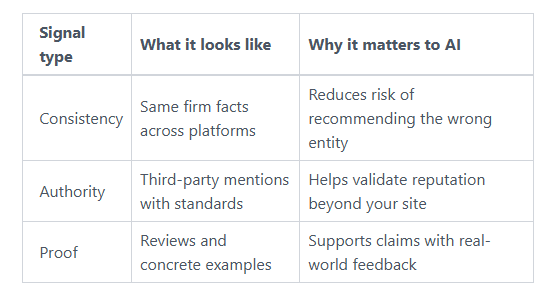
If the AI can't verify your basics in seconds, it won't gamble on you.
Consistency signals, your name, address, services, and attorney profiles match everywhere
Consistency is not a branding detail — it's the foundation of entity-based presence. When AI systems can confirm your firm is the same entity across every platform, their confidence in recommending you goes up.
Common mismatches that quietly hurt you include an old firm name on a directory, two phone numbers used at random, or a suite number that varies by platform. Attorney profiles can also create confusion, especially when lawyers appear tied to multiple firms without clear context.
You don't need perfection, but you do need alignment. A single "wrong" listing can act like static on a call. The AI hears it, then chooses a clearer signal.
Authority signals, other trusted sources talk about you in a verifiable way
Authority comes from sources that don't belong to you. Mentions in local news, bar associations, speaking events, and community organizations often carry more weight than paid placements on low-quality sites.
Relevance matters more than volume. A niche mention tied to your practice area and region can help more than a generic list of "top firms" with no criteria. AI also tends to trust outlets with editorial processes, because they reduce spam and fake claims.
If you invest in visibility, focus on legitimacy. You want signals that still look real two years from now.
Proof signals, reviews, case examples, and client-friendly explanations
Reviews matter because they show patterns. AI summaries often reflect volume, recency, and detail. One glowing review won't outweigh a long gap or a set of vague comments.
You can also publish anonymized case stories where allowed, framed carefully. Avoid promises and avoid "guaranteed" language. Instead, explain what you did, what the process looked like, and what factors shaped the outcome.
Client-friendly explanations help too. When your pages answer real intake questions, the AI has something useful to quote.
What knocks you out of AI recommendations, even if you are a great lawyer
Some problems don't show in your win rate. They show in your digital footprint. Without a coherent entity-based presence, even excellent firms become invisible to AI."
Thin, generic practice pages that look like everyone else
A copy-paste practice page makes you invisible. If every firm says "we fight for you," the AI can't tell who actually handles the case type the user asked about.
Add specifics that help the AI and the client. Mention jurisdictions you serve, typical fact patterns, and what happens after the first call. Include FAQs based on what your intake team hears every week. Those details create separation without hype.
Mixed signals and missing basics, outdated content, unclear locations, and no next step
AI recommendations often fail on basic usability. If your contact path is unclear, the system assumes friction. If your hours, locations, or service areas conflict, it assumes risk.
Keep bios current. Make your phone number easy to find. State your service area plainly. Also, check mobile performance and accessibility. If a client struggles to read your site, the AI may treat that as a quality problem too.
How you can make your firm easier for AI to recommend, without chasing hacks
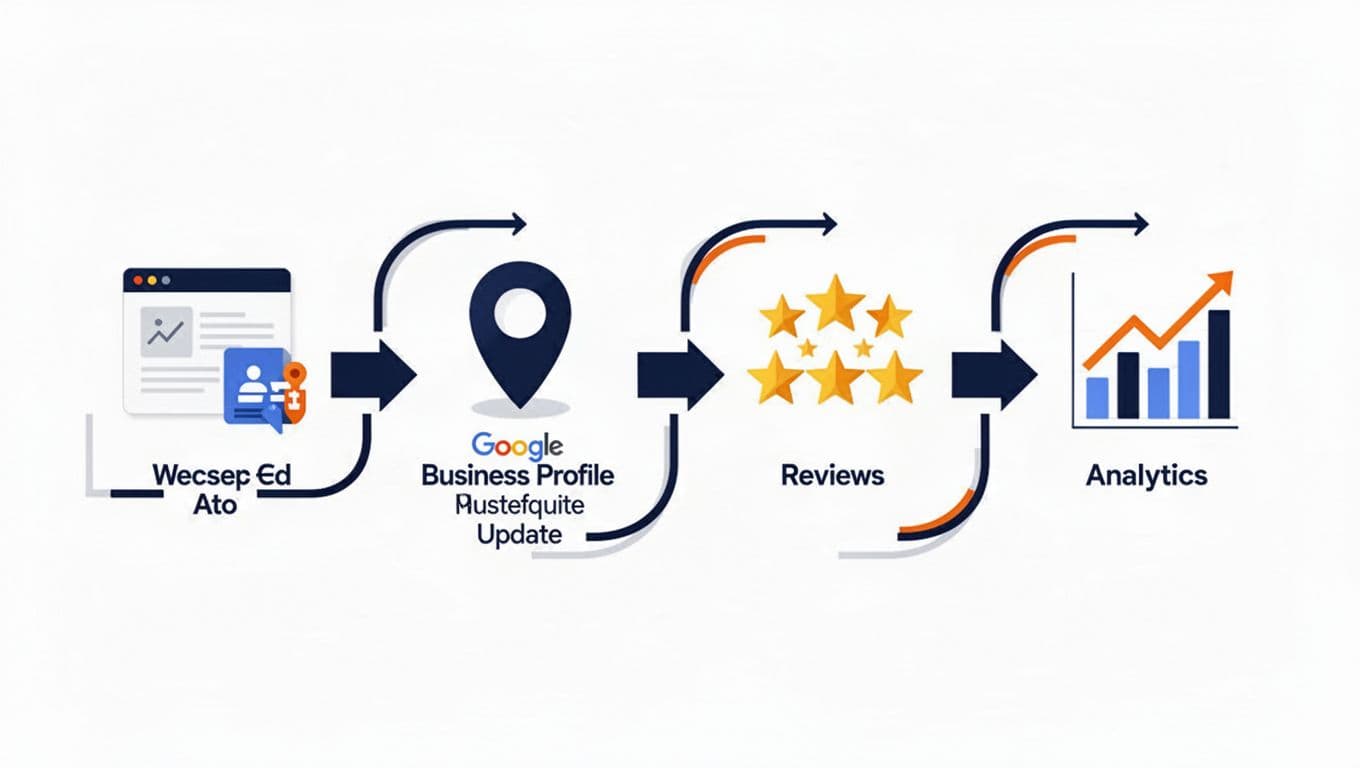
An action-focused roadmap that mirrors how you can improve clarity and trust signals over 30 to 90 days, created with AI.
You don't need tricks. You need a footprint that reads like a clean file folder, not a junk drawer.
A simple 30 to 90-day plan works well:
- First 30 days: fix NAP mismatches, update bios, clarify practice pages.
- Next 30 days: publish client FAQs and strengthen location clarity.
- Final 30 days: build third-party credibility and tighten review flow.
Create a "client questions" content plan that AI can quote safely
Build pages around the questions people ask before they hire you. Keep the answers general, and invite consultation for advice. That keeps you helpful without crossing ethical lines.
Start with one strong service page per main practice area. Add location pages only where you truly serve clients. Then create a FAQ hub that covers questions like typical timelines, what documents help, what the first call includes, and what fees depend on.
If you want to adjust your message to different client needs without sounding inconsistent, content personalization in legal marketing can help you plan it carefully.
Strengthen your digital footprint where clients and AI both look
Keep your Google Business Profile tight, with accurate categories, services, photos, and hours. Monitor key directories that show up in your market. Create a consistent review request process that encourages detail, not just star ratings.
Then track what happens. Watch which pages lead to calls. Note which questions people still ask after reading. Update key pages quarterly so your information stays fresh and aligned. For measurement basics, law firm website analytics gives you a clean starting point.
Conclusion
AI recommends law firms it can understand, verify, and explain fast. That's what entity-based digital presence is — making your firm readable, verifiable, and trustworthy to both machines and the people they serve. That's why clarity, consistency, and credible proof beat clever copy every time. Start by auditing your top pages and listings for mismatches, then improve one core practice page and one FAQ set first. Build outward from there, and you'll earn stronger recommendations because you made it easy for both clients and AI to trust you.
Ready to find out what AI systems currently say about your firm? Call (231) 744-6475 or book a strategy session at https://calendly.com/lynn-lively-lively-designs
Slow load times, poor mobile design, weak content, and missing on-page SEO elements (like headers and schema) are all common. We fix these with custom audits and strategic redesigns.
ABSOLUTELY, but it’s tough. Lively Designs uses a hybrid strategy combining SEO and paid ads to dominate Page 1 faster and more reliably, especially in high-competition areas like personal injury or criminal defense law.
Entity SEO helps Google understand your law firm as a distinct, authoritative brand. It uses structured data, consistent mentions, and content relationships to build trust and boost rankings in competitive legal searches.
SEO improves your law firm’s visibility in search engines, helping potential clients find you when they search for legal services. More visibility means more website traffic, and with the right conversion tactics, more leads.
Businesses use tools to see how many people click, visit, or buy after seeing their ads or posts.
Online reviews are opinions shared by customers about a business. Good reviews make people trust a business more.
Content marketing is sharing helpful or interesting information, like blogs or videos, to attract and keep customers.
Businesses send emails to people with offers, updates, or tips to keep them interested in their products.
PPC (Pay for Click) is when businesses pay every time someone clicks on their online ad.
SEO, or Search Engine Optimization, is a way to make a website show up higher on Google and other search engines.
Social media allows businesses to share updates, talk with customers, and advertise directly to people who might like their products.
Examples include Google ads, social media posts, email newsletters, and creating helpful videos or blogs.
It helps businesses connect with more people online, where most customers spend their time.
Digital marketing is promoting products or services using the internet, like websites, social media, and email, to reach customers.

Lynn A. Lively - Professional Biography
Founder & Managing Partner, Lively Designs
Lynn A. Lively is a distinguished digital strategy leader with nearly two decades of experience helping law firms and service-based businesses compete—and win—in the evolving digital economy.
As Founder and Managing Partner of Lively Designs since 2007, Lynn has led the agency's transformation into a trusted authority on entity-based marketing, AI-era visibility, and digital trust-building, serving clients across the U.S. and Canada in ultra-competitive markets. Known for his analytical mindset and adaptability, Lynn blends technical depth with a client-first approach, specializing in digital ecosystem architecture, AI-influenced brand positioning, structured content strategies, and high-performance website design focused on entity recognition.
Lynn's comprehensive expertise spans from managed IT services and VoIP systems to high-impact web design and digital marketing, delivering what he calls "concierge-level services" that help SMBs navigate the digital landscape with confidence.
His work has consistently helped clients rise to the top in highly competitive legal and B2C markets by earning recognition not just from search engines, but from AI systems, platforms, and real people. Lynn's passion for continuous learning drives his work in digital marketing, where he continually adapts to new challenges and brings expertise to clients on local, regional, and national levels.
Beyond his role at Lively Designs, Lynn actively mentors SMBs through digital transformation, partners with top-tier developers like TWalkerCo, and continues to research the future of AI search, local authority signals, and zero-click behavior. Under his leadership, Lively Designs has become known for blending technology and marketing to create seamless solutions that boost online presence, streamline operations, and generate lasting results. His mission remains focused on transforming complex digital challenges into sustainable success stories for businesses seeking to dominate their industries online.
References:
Professional Profile: LinkedIn.com/in/lynn-lively-b23793a/
Company Information: Lively Designs About Us - https://www.lively-designs.com/about-us


.webp)